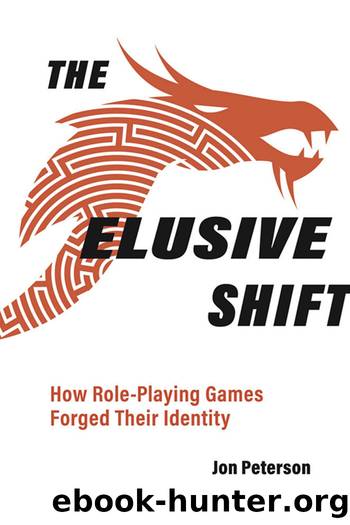
The Elusive Shift by Jon Peterson
Author:Jon Peterson [Peterson, Jon]
Language: eng
Format: epub
Tags: Role-playing games; Dungeons & Dragons; fan culture; theory; philosophy; Gygax; Arneson; Blacow; Pulsipher; Lortz; Simbalist; fanzine; zine; Tunnels & Trolls; Chivalry & Sorcery; abilities; alignment; progression; experience; stories; narrative; in character; out of character; dungeon master; referee; role-playing
Publisher: MIT Press
Published: 2020-11-27T00:00:00+00:00
Figure I.1
Digest-size unofficial supplements sized for inclusion in the original Dungeons & Dragons box. Shown: The Book of Monsters (1976), The Arduin Grimoire (1977), The Wizardâs Aide (1977), and Eâa: Chronicles of a Dying World (1979).
Even a title as far removed from fantastic medieval dungeon exploration as Superhero â44 claimed it originated as a D&D variant. The designer, Donald Saxman, explains how local campaign referee Mike Ford had introduced into his D&D game âa device which allowed the players to travel to over two dozen alternate universes, each with its own natural laws and historical motif.â Among those parallel dimensions was one âpopulated with comic-book and pulp-novel characters,â where âthe party of magicians and swordsmen met Batman and Doc Savage, and ultimately fought Doctor Doom and Darkseid with the help of Luke Cage and the Phantom Stranger.â4 This naturally occasioned the development of variant systems for those comic-book entities, which in turn spurred Superhero â44. But what was left of D&D in it? Whoâs to say if it was or was not D&D at that point?
At that extreme, to Costikyanâs point, we might say that D&D had effectively dissolved in its own plasticity. What remained was a hobby, floating atop a more fluid implementation of the role-playing experience, which called itself âFRP,â for âfantasy role playing,â but moored itself to no design. As alarming as the notion that âthere is no such game as Dungeons & Dragonsâ might have been to Gygax and his colleagues, it also boded poorly for any competing designs as well. The sheer prevalence and scope of variant implementations of D&D deflated any presumed urgency to base a campaign on any ânext-generationâ system published outside the D&D franchise.
Jim Thomas, writing in Wild Hunt 22, weighed the advantages of switching to one popular competing game system: âI, too, think that Chivalry & Sorcery is a neat book, full of all sorts of dandy ideas. It might well be a better starting point for a fantasy role-playing âgameâ than Dungeons & Dragons was. And I have a strong hunch that nothingâs ever going to be more than a starting point.â If every published design represented only a starting point for a lengthy and open-ended process of patching or extending rules, then how much did it matter whether the referee based a game on D&D or on any of its competitors of the era?
Whether a set of variant rules had achieved sufficient autonomy to warrant designation as an independent game also had no objective markers: as Lee Gold would advise in 1977, âIf your house rules run more than thirty pages, I suggest you consider youâve invented a new game and copyright itâ (AE 29). It was not hard to hit that mark because everyone was constantly hacking the system. Kevin Slimak, feeling âtired of trying to kludge a good game out of Gygax D&D,â decided on a solution: âStop pretending to be playing D&D; call the game something different and rework/rewrite the rules to my own tasteâ (WH 5).
Download
This site does not store any files on its server. We only index and link to content provided by other sites. Please contact the content providers to delete copyright contents if any and email us, we'll remove relevant links or contents immediately.
| Anthropology | Archaeology |
| Philosophy | Politics & Government |
| Social Sciences | Sociology |
| Women's Studies |
Cecilia; Or, Memoirs of an Heiress — Volume 1 by Fanny Burney(32558)
The Great Music City by Andrea Baker(32019)
Cecilia; Or, Memoirs of an Heiress — Volume 2 by Fanny Burney(31956)
Cecilia; Or, Memoirs of an Heiress — Volume 3 by Fanny Burney(31942)
We're Going to Need More Wine by Gabrielle Union(19046)
All the Missing Girls by Megan Miranda(16028)
Pimp by Iceberg Slim(14507)
For the Love of Europe by Rick Steves(14121)
Bombshells: Glamour Girls of a Lifetime by Sullivan Steve(14075)
Talking to Strangers by Malcolm Gladwell(13370)
Norse Mythology by Gaiman Neil(13365)
Fifty Shades Freed by E L James(13241)
Mindhunter: Inside the FBI's Elite Serial Crime Unit by John E. Douglas & Mark Olshaker(9343)
Crazy Rich Asians by Kevin Kwan(9292)
The Lost Art of Listening by Michael P. Nichols(7506)
Enlightenment Now: The Case for Reason, Science, Humanism, and Progress by Steven Pinker(7313)
The Four Agreements by Don Miguel Ruiz(6765)
Bad Blood by John Carreyrou(6621)
Weapons of Math Destruction by Cathy O'Neil(6280)
